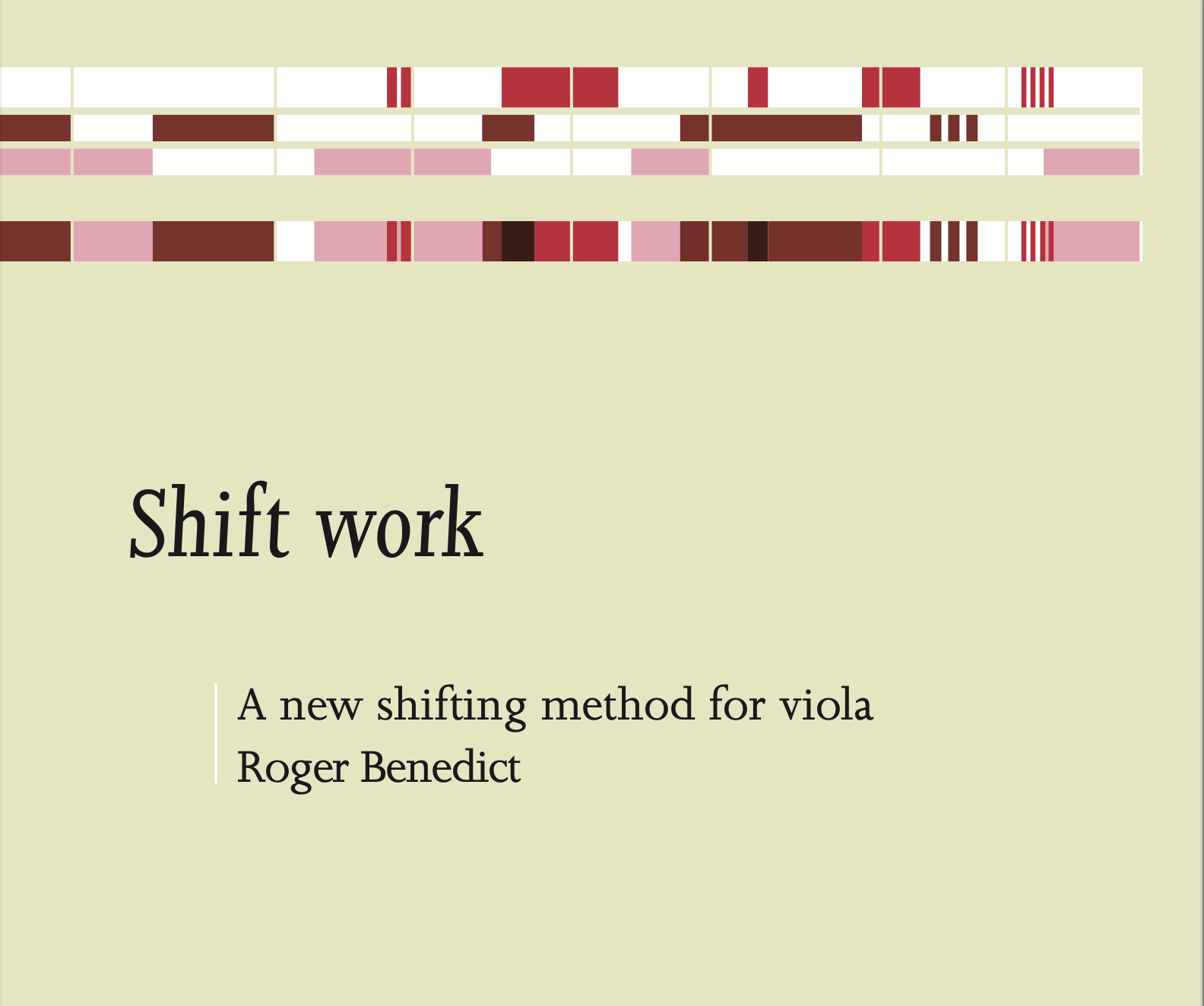
Review: “Shift Work” by Roger Benedict
Partitura-Verlag, the publisher of “Shift Work,” has kindly offered a 20% discount on this title to my readers.
To receive your discount, send an email to "info@partitura-verlag.com“ with the subject line, “Order Shift Work - String Theory Blog," and the publisher will send you a payment request that reflects the discounted price.
TL;DR
Benedict's "Shift Work" is a fantastic companion to his scale book, "Scale Up." Intermediate to professional players will find helpful exercises to increase their confidence, comfort and ease navigating the fingerboard, clear and concise instructions on the mechanics of each kind of shift, and intuitive exercises to develop fluency in them. Players seeking to improve their double stop shifting will find this book particularly helpful. IMHO, regular practice of the exercises in "Shift Work" will lead players to faster improvements than time spent on that old shifting warhorse, Ševčík Op. 8: this was certainly the case for me!
Full Review
Playing in tune with confidence should be a primary goal of any string player. I say "should" because, for most of my youth, I just didn't care that much about intonation! That might sound ridiculous, but at the time, I simply didn't understand what all the fuss was about, and I was mystified by my colleagues that obsessed over the intonation of every note. Don't get me wrong, I cared a lot about my SOUND, and wanted to play with a beautiful tone, but it took me an embarrassingly long time to make the connection between sound quality and intonation: that "tone" is inside "in-ton-ation" (well, at least if you spell it in German, "ton").
I realized the error of my ways a long time ago, but I often still feel like I'm catching up on those early years when I neglected my intonation, and am always on the lookout for resources that can improve my own left hand confidence. Roger Benedict's new book "Shift Work" is an excellent addition to that list.
Preliminary Exercises
Four preliminary exercises help establish a healthy hand frame, reinforce different finger patterns in first position and improve finger and joint flexibility.
Keeping non-playing fingers down is a tenet of Benedict's left hand approach: he recommends players with smaller hands release the 1st finger when necessary to avoid excess tension. I could (and probably should!) write a whole post on the fingers down/releasing fingers debate, but I'll save that for another time! Suffice it to say that whichever side of the issue you fall on, we can all agree that every violist, regardless of hand size, has to play double stops, so being able to keep at least two fingers down is critical. Benedict has two excellent exercises for developing this skill, and by extension, the basic hand frame. In particular, his exercise in octaves has become a regular part of my warm-up.
One aspect of these preliminary exercises I appreciated is the attention devoted to the ability to contract the hand (think of playing chromatic scales, or playing a tritone as a double stop). There are books with great exercises for extensions, but these were some of the first exercises I had come across developing contractions. After practicing them I found immediate improvement in some of the finger-twisting chordal sections of Bach's Violin Sonatas and Partitas.
Basic Shifting
The first big section of the book focuses on developing three kinds of shifts, which Benedict labels simple, substitution and bridging. He defines them this way:
Simple - shifting with the same finger
Substitution - shifting from a higher finger to a lower finger
Bridging - shifting from a lower finger to a higher finger
The main vehicle for practicing these shifts is a one-octave scale in leaps, like so:

In the opening part of each of the simple shift exercises, Benedict's inserts an open string between every note, like so:

Though I regularly practice one finger scales in leaps, I had only tried inserting an open string between the notes (on advice from Notebook for Viola Players) once or twice. Wow, is it both helpful and HARD! The open string forces you to release tension in the hand every time you shift AND emphasizes/reinforces the kinesthetic sense of where the note is on the fingerboard. As if that weren’t enough, it also requires you to hold the destination pitch in your mind as you shift, which is no small task since the open string is also not always part of the key (think open C’s when you’re playing in any sharp key other than G major).
Several times in the book, Benedict advises, "Don’t adjust the finger if it lands out of tune – merely repeat until correct." As a serial adjuster, who perhaps hadn't admitted it to himself until recently, it felt as if Benedict was staring out of the page, talking straight to me as he wrote those words! Mimi Zweig has a maxim that students need to be ready to receive the information before they can absorb it. While I had heard Benedict's advice about not adjusting before, this time I was ready to receive it, and man did I have to repeat a lot of the shifts in the higher positions more times than I care to admit!
I appreciate that Benedict mixes in many different keys throughout the book, along with the standard minor scales (natural, melodic and harmonic). He also finds creative ways to ensure that you always feel the exercises and the hand frame within a broader harmonic structure—for example, in the section with shifts that only use one finger, he includes an exercise that includes the other fingers in the key.
Benedict suggests practicing the exercises in this section chromatically as well, and while there is one chromatic exercise in the section on Double Stops, this section would have benefitted from at least one chromatic exercise, for the same reason he writes in the intro:
I could have just provided each of the exercises in one key and one finger combination and suggested that they are transposed into different keys and finger combinations by the reader. My experience is that the likely result of this approach would be that only the printed exercises get practised regularly.
Double Stop Shifting
My favorite part of this book is the section on double stops. 3rds and 6ths are the focus, with a "fun" exercise that adds 4ths and 5ths at the end of the book.
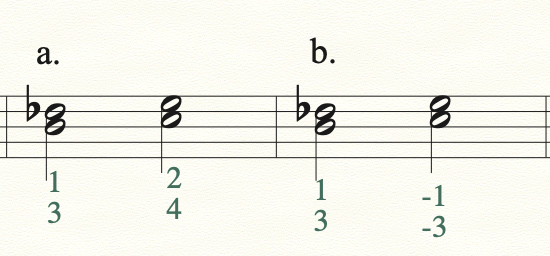
3rds and 6ths come in two main qualities, major and minor. When moving between pairs of 3rds or 6ths of the same quality (AKA "parallel" 3rds/6ths), you can use consecutive finger pairs (ex. a), but it often feels more natural to use the same pair of fingers, since those fingers keep the same space between them (ex. b):
But what about if you HAVE to shift using the same pair of fingers AND the quality of the double stop changes? How do you negotiate the fact that each finger is shifting at different speeds? This may seem like a niche problem, but it pops up all the time, as in this passage from Paganini's "Sonata for the Grand Viola:"
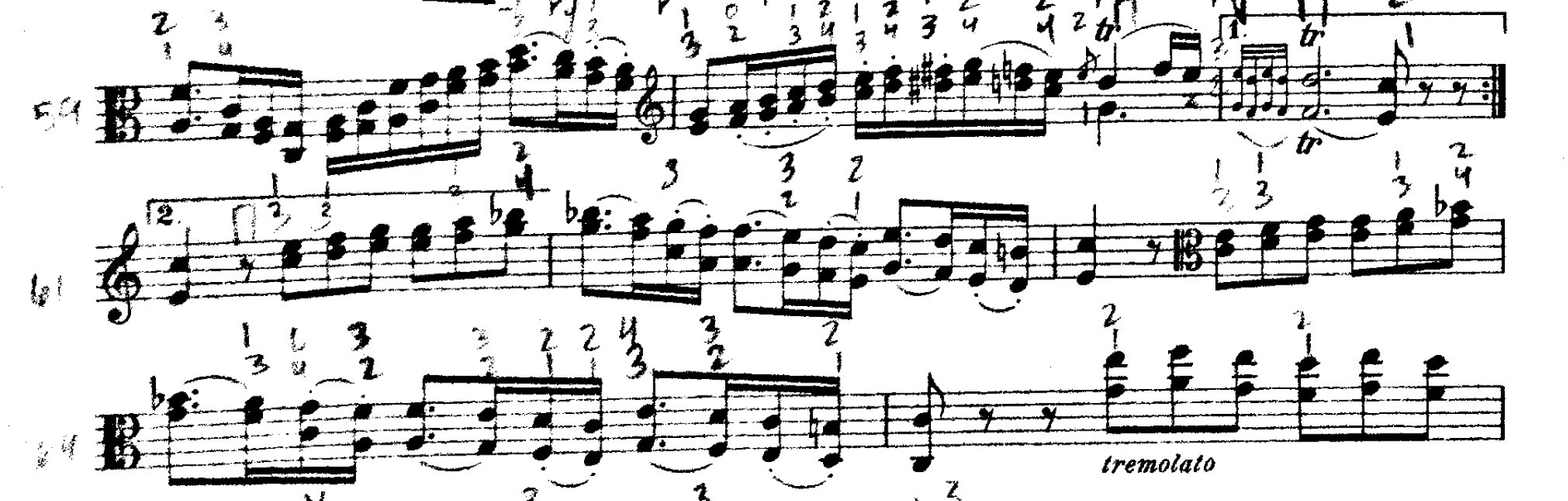
Paganini Sonata for the Grand Viola - pg 2
Benedict has an ingenious exercise for solving this problem, and after practicing it for just a few minutes I instantly noticed a difference when I played through the Paganini excerpt. No exaggeration, I would have paid the entire cost of the book just for this exercise!
This famous passage from the first movement of the Walton Concerto was also much more fluid after work on the non-parallel 6ths and some later exercises on double-stop substitution shifts:
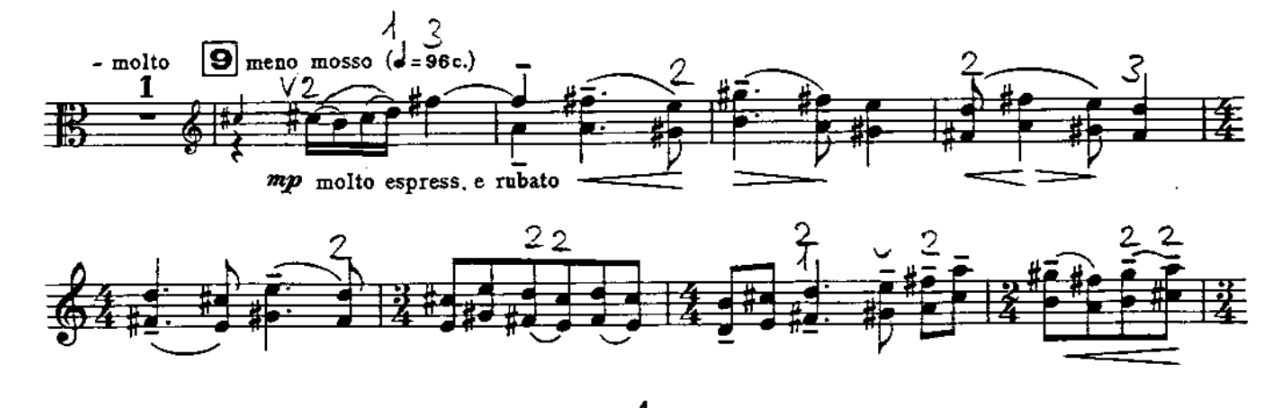
Walton Viola Concerto - first movement
Almost as an afterthought, the end of the book has a knotty/naughty exercise that adds 4ths and 5ths to the mix, which I appreciated, as these important intervals are often neglected in many scale/exercise books. At the time of this review I was learning Villa-Lobos' String Quartet #11, which features a number of awkwardly written passages in 4ths, like this:
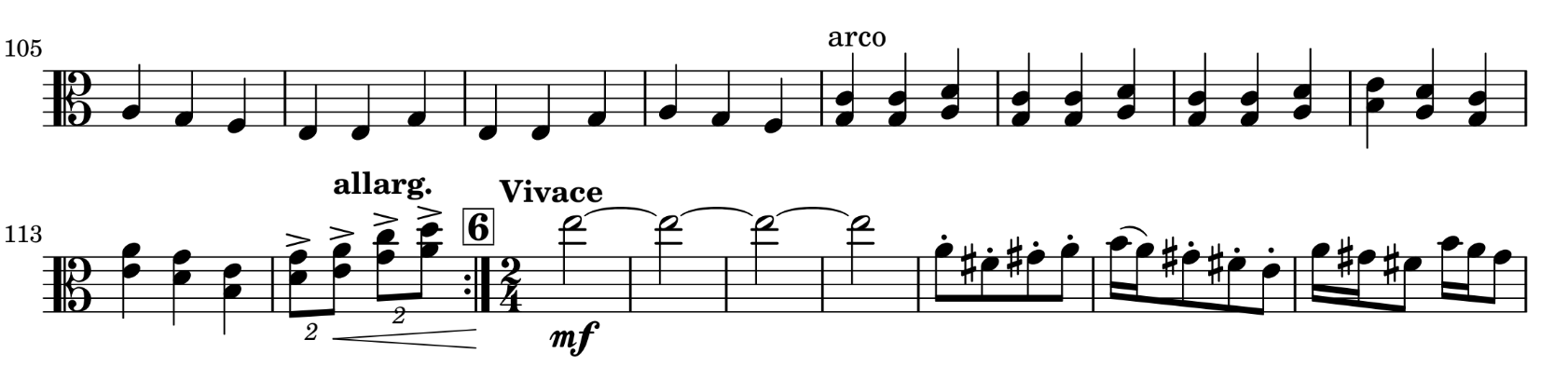
Villa lobos Quartet #6 - first movement
Warming up with a few lines of Benedict's exercise made these passages feel much easier!
Summary
“Shift Work” is a fantastic pedagogical resource that belongs on the stand of any violist looking to improve their left hand. The exercises in "Shift Work" have become a regular part of my technical routine. I cycle through keys chromatically as part of my regular scale practice, and my current strategy is to work on a few "Shift Work" exercises in my key of the day, then move over to "Scale Up" and play a few exercises in the same key. By starting with those exercises, my shifts in the scales were a cinch!
With "Shift Work" and "Scale Up" Roger Benedict has given us a wide-ranging vision of his approach to the left hand. Vibrato is the only major topic missing from these two books—I hope we will get his thoughts on that topic at some point! And if it's not already in the works, I hope Benedict considers writing a book on the bow arm, I’m very interested to learn his approach!
“Shift Work” is published by in Switzerland by Partitura-Verlag. It is available in print and as a digital download. I highly recommend the digital version, which is what I reviewed. It looks great on my iPad, and it’s easy for me to check off exercises as I do them (and hide that layer when not needed).
Here are links to both versions:
Print Version | Digital Download
There are some great sample pages from the book which you can view on their site. Enjoy!
Partitura-Verlag, the publisher of “Shift Work,” has kindly offered a 20% discount on this title to my readers.
To receive your discount, send an email to "info@partitura-verlag.com“ with the subject line, “Order Shift Work - String Theory Blog," and the publisher will send you a payment request that reflects the discounted price.





All the videos I made as part of my time as an American Viola Society Digital Artist-in-Resident.